
Macon Public Records Coverage
Georgia favors access to government files, yet access depends on the record and its custodian. Macon-Bibb general departments route requests through the consolidated government. Courts, the Sheriff, Probate Court, health officials, and elections staff keep separate channels. The first screen below shows where major public records live and what an online result actually means.
| Record set | Custodian | Online index | Access |
|---|---|---|---|
| Deeds, liens, plats | Bibb Superior Court clerk | GSCCCA and Cott, with category-specific Bibb coverage | Index and paid images; clerk copies |
| Superior and State cases | Respective court clerk | Provider through Georgia e-access | Account may be needed; clerk is authoritative |
| Assessment and tax | Board of Assessors and Tax Commissioner | Official assessor and current tax portals | Web inquiry; archived cards or digests by request |
| Estates and marriage | Bibb Probate Court | Layered probate indexes, no single complete free search | Counter, written request, or certified copy |
| Birth and death | County Health Department or Georgia DPH | No unrestricted modern name index | Application, identification, and eligibility rules |
| Jail and state custody | Bibb Sheriff or Georgia DOC | Separate official locators | Free locator; fuller reports by request |
Sealed court matters, adoption files, most juvenile records, protected identifiers, certain active investigative material, and restricted vital certificates do not become open merely because related indexes are public. Driver information also falls under federal privacy law. A missing index row can reflect coverage or confidentiality, so it cannot prove that no file exists.
Search Macon Deed Records
The Bibb Clerk of Superior Court records deeds, security deeds, liens, plats, trade names, and notarial material. Bibb's Cott coverage is not one blanket start date. Real-estate records run from January 3, 1950 through 1997, followed by Georgia Land Records from 1998 forward. Lien, plat, financing-statement, and hospital-lien categories have their own dates. The statewide GSCCCA Real Estate Index supplies the main search interface, while official copies remain available from the clerk.
| Search field | Type | Needed? | Use |
|---|---|---|---|
| County or region | Selector | Yes | Choose Bibb for Macon records |
| Name | Person or entity text | Conditional | Search grantor or grantee, including variants |
| Party and instrument type | Filters | No | Narrow a role or recorded document class |
| Recording dates | Date pair | No | Limit the filing window |
| Subdivision, unit, block, lot | Property fields | Conditional | Works when no street address was indexed |
| Book and page | Number pair | Conditional | Jumps to a cited instrument |
The official deed-index screen shows how geography, name, instrument, date, property, and book/page criteria work together.
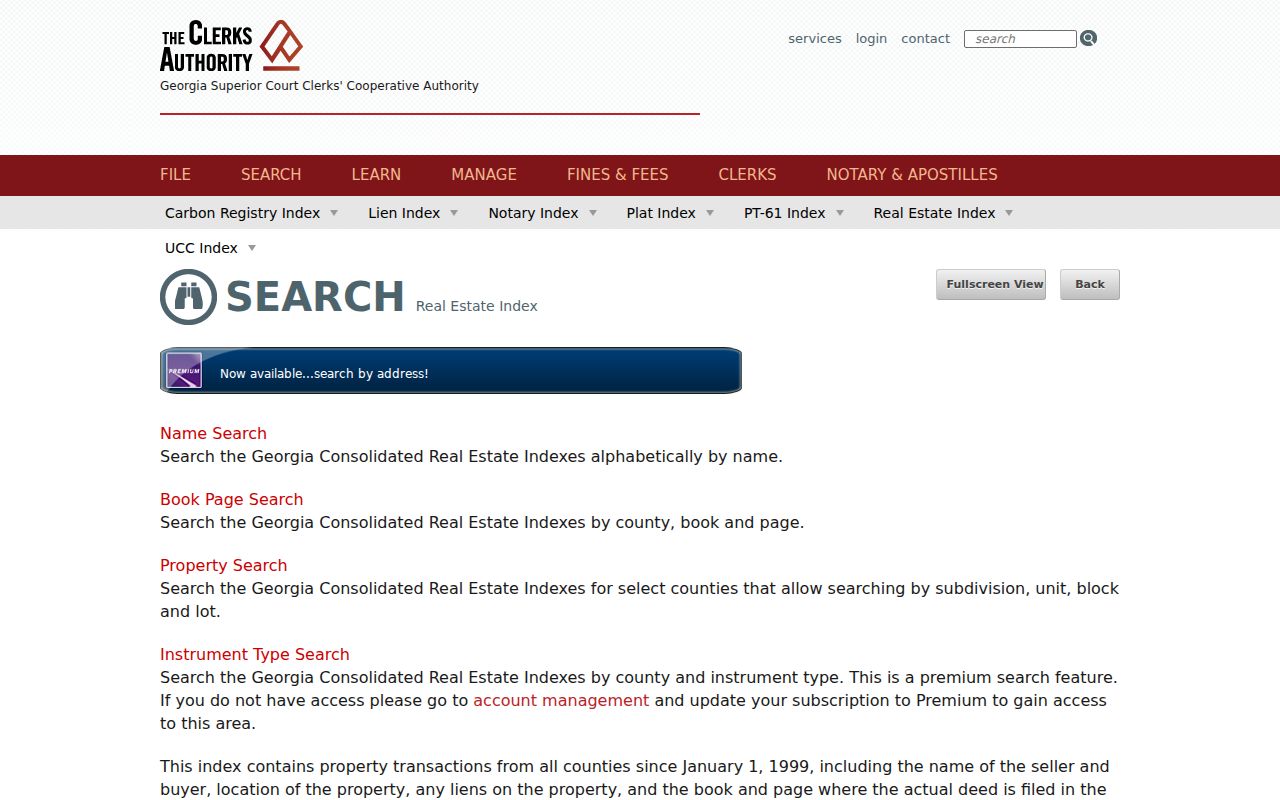
The screen is an index doorway, not the deed itself. Result rows can identify parties, property location, recording data, and book/page, while images may require an account and cost 50 cents per page.
Macon Records Book-Page Shortcut
A book/page citation is the cleanest bridge between Macon systems. It can appear on a parcel card, permit file, plat, prior deed, or agency exhibit. Entering that pair in the land index avoids spelling problems and separates people or entities with similar names. A recorded deed can then show the instrument type, grantor, grantee, recording stamp, legal description, return-to address, execution data, witness, and notary.
Insider tip. Copy every book/page cross-reference before leaving a permit or parcel source; it may lead straight into Bibb's 1950-forward title chain.
Grantor means the party conveying an interest. Grantee means the receiving party. Neither role alone proves where someone now lives, and a filed instrument should be read in the context of later deeds, releases, assignments, and liens.
Macon Property Record Divisions
Property information is split three ways. The Bibb Board of Assessors maintains assessment and parcel data. The Tax Commissioner portal handles current tax accounts and payments. The Superior Court clerk keeps title instruments. An assessment identifies the tax roll's owner, but it is not proof of title. A tax balance is not a deed.
The assessor and tax applications are dynamic, and the research did not verify every live field. Use the official portal, then call or visit the assessor at 653 Second Street, Suite 100, 478-621-6701 for an archived property card or help with a missing search. Tax Commissioner records are also available at 188 Third Street, 478-621-6500, including prior material that may not appear online.
The Macon-Bibb GIS resources add map and jurisdiction context to a parcel trail.

GIS can connect an address to a parcel or local layer, but map labels are not legal surveys. Use a plat and deed description when boundaries matter.
Note: A situs address names the physical parcel, while the mailing address shows where the tax notice goes and may point elsewhere.
Macon Court Records Access
Macon has Municipal, Magistrate, State, Probate, Juvenile, and Superior courts, plus the federal Middle District of Georgia. There is no single free Georgia trial-court database covering them all. The Georgia court e-access directory routes Bibb State and Superior searches to the participating provider, where an account may be required. A docket is the dated list of filings and events in a case. It may show parties, roles, case number, type, filing date, status, judge, hearings, entries, and disposition.
Provider coverage is court-specific, and linked images may be gated. The clerk holds the authoritative file and supplies certified copies. Municipal Court has no verified complete public party-name portal, so contact its clerk for public portions. Hearing recordings are retained for at least 90 days, making a prompt preservation request important. Probate and older court materials also require a counter or written search when web coverage ends.
A same-name result is not identity proof. Compare the full case context and ask the clerk about legacy indexes when the web produces nothing.
Macon Probate Records Reach 1823
Bibb's probate landscape is unusually deep and layered. The General Index reaches 1823 through 2004. RECORDhub probate images cover 1829 through 1989, Georgia Probate covers 2005 forward, Inferior Court material spans 1827 through 1863, and FamilySearch Court of Ordinary minutes cover 1827 through 1900. These are distinct bodies of public records, not duplicate doors to one complete index.
Search the layers that fit the event and era before declaring a gap. Bibb County was formed in 1822, so surviving name-bearing probate series begin near the county's first decade. Wills, administrations, guardianships, and estate papers belong to Probate Court. Marriage licenses and copies also come from Probate, while divorce files belong to Superior Court.
Note: No sound source supports a broad Bibb courthouse-fire loss, so do not assume a missing record burned.
Macon Vital Record Channels
Birth, death, marriage, and divorce records follow four paths. The Macon-Bibb County Health Department and Georgia DPH issue eligible birth and death certificates. Probate Court supplies marriage-license copies. Superior Court supplies divorce decrees, while DPH can provide a divorce verification within its covered period. Modern birth and death records are not unrestricted public name indexes.
The Georgia DPH ordering instructions provide online-vendor, mail, and walk-in routes. Applicants must use the current form, show acceptable identification, establish eligibility or a direct and tangible interest, and pay the current fee. O.C.G.A. sections 31-10-25 and 31-10-26 govern restricted access. Vendor charges can be added to the state fee.
Macon began local death registration in 1882 and birth registration in 1891, well before Georgia's statewide system began in 1919. Historical indexes and archive catalogs may therefore reveal early events that a modern certificate portal cannot browse.
Macon Custody Record Lookups
Local booking information begins with the Bibb Sheriff inmate search. State prison and supervision records use Georgia Department of Corrections Find an Offender. The GBI registry is a separate statutory public-safety system, not a full criminal-history database.
The official registry access page illustrates that separate channel.
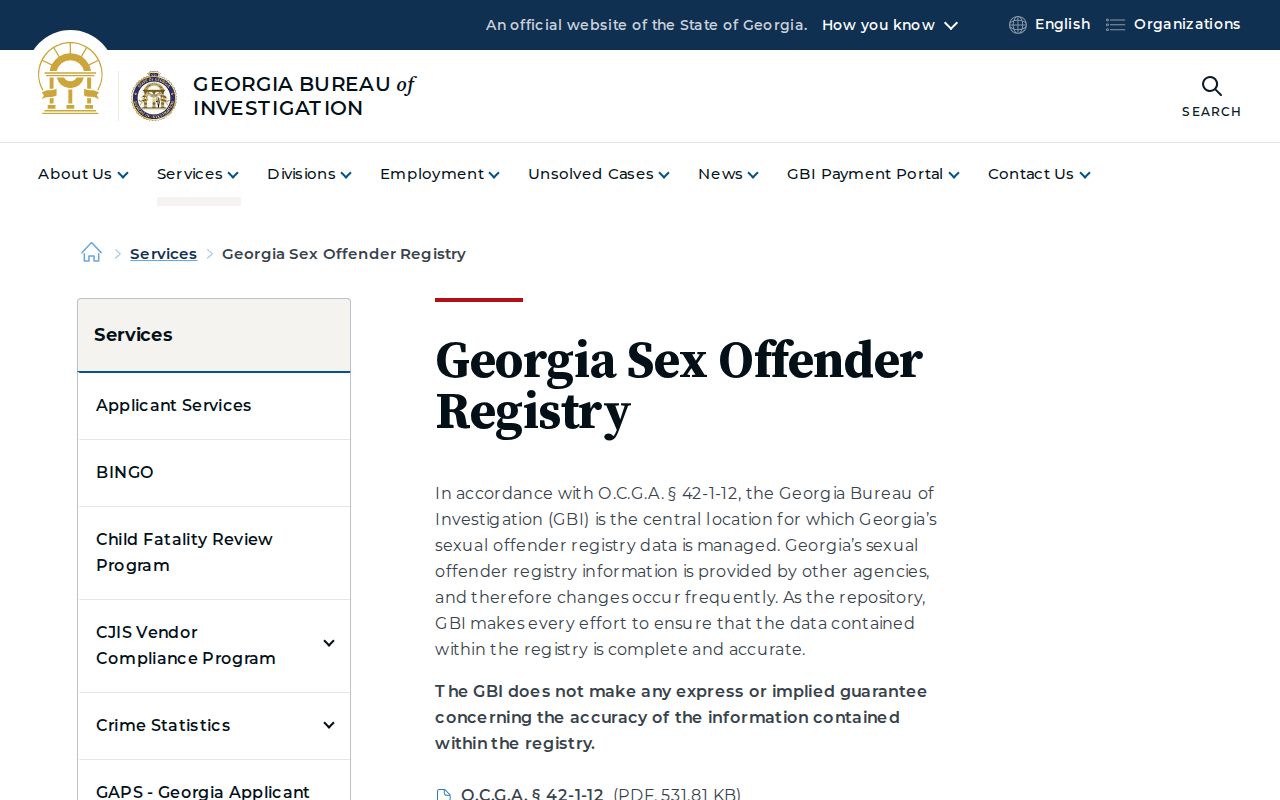
Published registry fields can include name, photo, physical description, offense, status, address, and supervising agency. Verify the current entry with GBI or the sheriff, and never use it to threaten or harass anyone. A booking charge is also an accusation, not a conviction.
For a fuller local incident or accident file, contact Sheriff Central Records with the incident number, date, time, location, and involved person's name when known. A released report may omit facts tied to an active investigation, a juvenile, a victim, medical data, or another protected identifier. Warrants should be checked with the issuing court or agency, since an old notice may no longer state the current status. Federal custody is separate again and uses the Bureau of Prisons locator.
Macon Public Records Custodians
Consolidation changed routing. General City of Macon and Bibb County functions have operated as Macon-Bibb since 2014, but courts and the Sheriff still have distinct records officers. Send the request to the office that created or keeps the file.
The official Macon-Bibb open-records page distinguishes the Clerk of Commission, Superior Court clerk, and Sheriff channels.

That routing matters. Health, Probate, and Elections records also go to their own custodians rather than the general commission channel.
Macon Records Terms Decoded
Several short terms prevent costly mistakes when ordering Macon records. They describe different levels of access and authority.
- Index
- A finding list with names and filing references, not necessarily the signed document.
- Image
- A scan of a filed page, sometimes behind an account or per-page charge.
- Certified copy
- A custodian-authenticated copy used when official proof is required.
- Custodian
- The office responsible for keeping and producing a particular record.
- Exemption
- A law allowing specific material to be withheld or redacted.
Ask whether the price quoted covers a search, plain copy, image access, or certification. Those products are not interchangeable. Macon-Bibb's Business and Development form states a 10-cent paper-copy charge and allows administrative costs, while other custodians and statutory records may use different schedules.
Request Macon Public Records
The Georgia Open Records Act, O.C.G.A. sections 50-18-70 through 50-18-77, does not demand magic words. It does require enough detail to identify existing records. Agencies must produce them within three business days or provide a written response with timing, cost, or the cited basis for withholding when production cannot occur that soon.
- Choose the custodian. Use the Clerk of Commission for a general Macon-Bibb department, the Superior Court clerk for its files, and the Sheriff records officer for Sheriff or E911 material.
- Describe records, not questions. Give exact names, address, case, parcel, permit or incident number, record type, and a narrow date range.
- Ask for the useful format. Request native electronic files when they already exist, and include contact and delivery details.
- Control the price. Ask for an estimate and a not-to-exceed threshold. Staff search, retrieval, and redaction time may be charged after the first 15 minutes.
- Address any withholding. Request the precise exemption and all reasonably separable, nonexempt portions. Narrow the scope if needed.
When a response remains disputed, the Georgia Attorney General open-government resources explain the Act and available enforcement routes. The agency may redact protected facts while releasing the rest.
Lawful use. Open access never permits stalking, repeated unwanted contact, threats, or exposure of a protected address. Respect redactions and confidentiality programs.